The State Hall
The world's best library keeps 200,000 books behind rope in a hall Charles VI built for walking through. Twelve euros buys the walk; none of the books can be read.
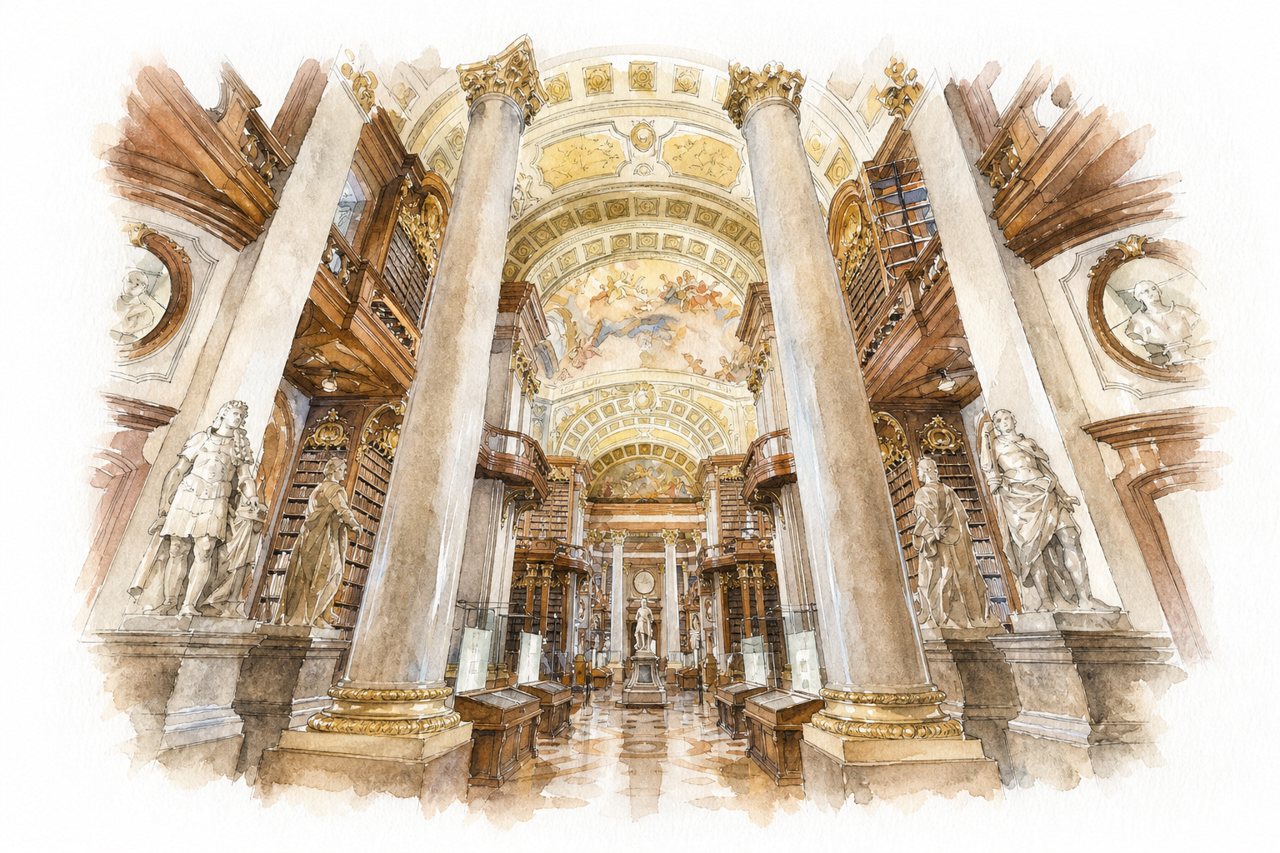
Josefsplatz gives nothing away. The Hofburg wraps the square with palace fronts of the standard Habsburg beige, riders in the school next door, a gate into the castle garden, and among it all a doorway with a small sign that says library. The ticket desk is up a stair, the cloakroom is another door, and then the wall stops and the hall begins: almost eighty metres of it, twenty high, dark walnut bookcases to the ceiling on both levels, a dome at the centre with a fresco the colour of dawn, and on the floor below, arranged like a state occasion, the whole visitor population of Vienna walking slowly with their phones out. Everyone photographs the same axis, from the centre of the hall towards the dome, and everyone steps on the same marble to do it, because that is what the hall was built for.
The books are older than the building and the institution is older than both. The Habsburgs were collecting by 1368, when Duke Albert III owned a golden Gospels written out in gold letters by Johannes of Troppau; Maximilian I married the books of Burgundy along with Mary of Burgundy, a dowry library worth 100,000 gulden, about an eighth of the whole. The court bought and inherited for 350 years, and when Prince Eugene of Savoy's 15,000 volumes arrived in the 1720s the dynasty ran out of room. Charles VI authorised a permanent home in 1722; Johann Bernhard Fischer von Erlach began the wing in 1721 and died two years later, and his son Joseph Emanuel finished it. The State Hall opened in 1726 holding about 200,000 volumes, and it has kept them: printed between 1501 and 1850, bound in leather, shelved behind a rope.
The frescoes explain what kind of room you are in. Daniel Gran painted the dome as the apotheosis of the emperor who paid for it: Hercules and Apollo hold the portrait of Charles VI aloft while allegories of the Habsburg virtues arrange themselves around him in complicated agreement. One end of the hall is decorated for war, the other for peace. The centre is a statue of Charles VI in marble, by the Strudel brothers, and the arrangement makes the point of the whole building: the emperor stands where the reader should be, and the books face him. Under Maria Theresa the dome cracked and had to be strapped with an iron ring by her court architect, which is the most Viennese sentence available about a library. In 1920 the imperial collection became the Austrian National Library; in 1966 the working collections moved to the Neue Burg across the square, and the hall settled into its third career as a museum of itself, restored in 2022 for the first time since 1955.
What a ticket buys today is the walk, and the walk is short. Enter at the side, the full length to the dome, around the reading desks with the old card index inlaid like a sunburst, past the four Venetian globes by Vincenzo Coronelli, each over a metre across, under the galleries with their roped staircases, and out past the shop. The house estimate of the visit is honest: ten to twenty minutes. The books cannot be touched, opened, or read; the readers who once filled those desks work elsewhere; the library's reading rooms are across town and cost €4 a day, and a reader's annual ticket costs less than two visits to the hall. The State Hall costs €12, the audio guide €3, and on Thursday evenings in summer the hall stays open until nine and the crowd thins enough to hear it: nothing. The silence of a room built for an audience of one.
So the question the list poses is a fair one. N° 1 of Libraries 2026 is a library you cannot read a book in, and I walked out after twenty minutes with a postcard. The rank stands anyway, and the reason is that the list ranks places, not services. No working library on earth does to a visitor what this hall does in its first ten seconds, and none of the great reading rooms still standing, Oxford's or Washington's or Prague's, has Charles VI standing in the middle of the floor. The library has been relieved of its duties and kept as a jewel box, and that is precisely why everyone comes.
Practical
State Hall, Austrian National Library, Josefsplatz 1, 1010 Vienna; U3 to Herrengasse. June to September Monday to Sunday 9 to 18, Thursday to 21; October to May Tuesday to Sunday, closed Mondays. Adults €12, reductions €10, under 19 free; audio guide €3 in eight languages; a €21 weekly ticket covers all the ÖNB museums. The Globe and Esperanto museums in Palais Mollard are a separate €6 combination. Allow fifteen minutes or half a day, depending on how much you like the binding of old books. Free with the Vienna Pass.
- Austrian National Library, onb.ac.at, 2026: admission fees, opening hours, the 200,000 volumes, the Coronelli globes, the 2022 restoration.
- Petschar, Hans, History of the Austrian National Library: the 1368 Gospels, Prince Eugene's 15,000 volumes, Fischer von Erlach's wing.
- Austrian National Library, price list 2025: the €4 reading-room day ticket at Heldenplatz.