Terme Berzieri
Italy’s best-ranked bath is an Art Nouveau palace with rooftop pools, and not a drop of thermal water in them.
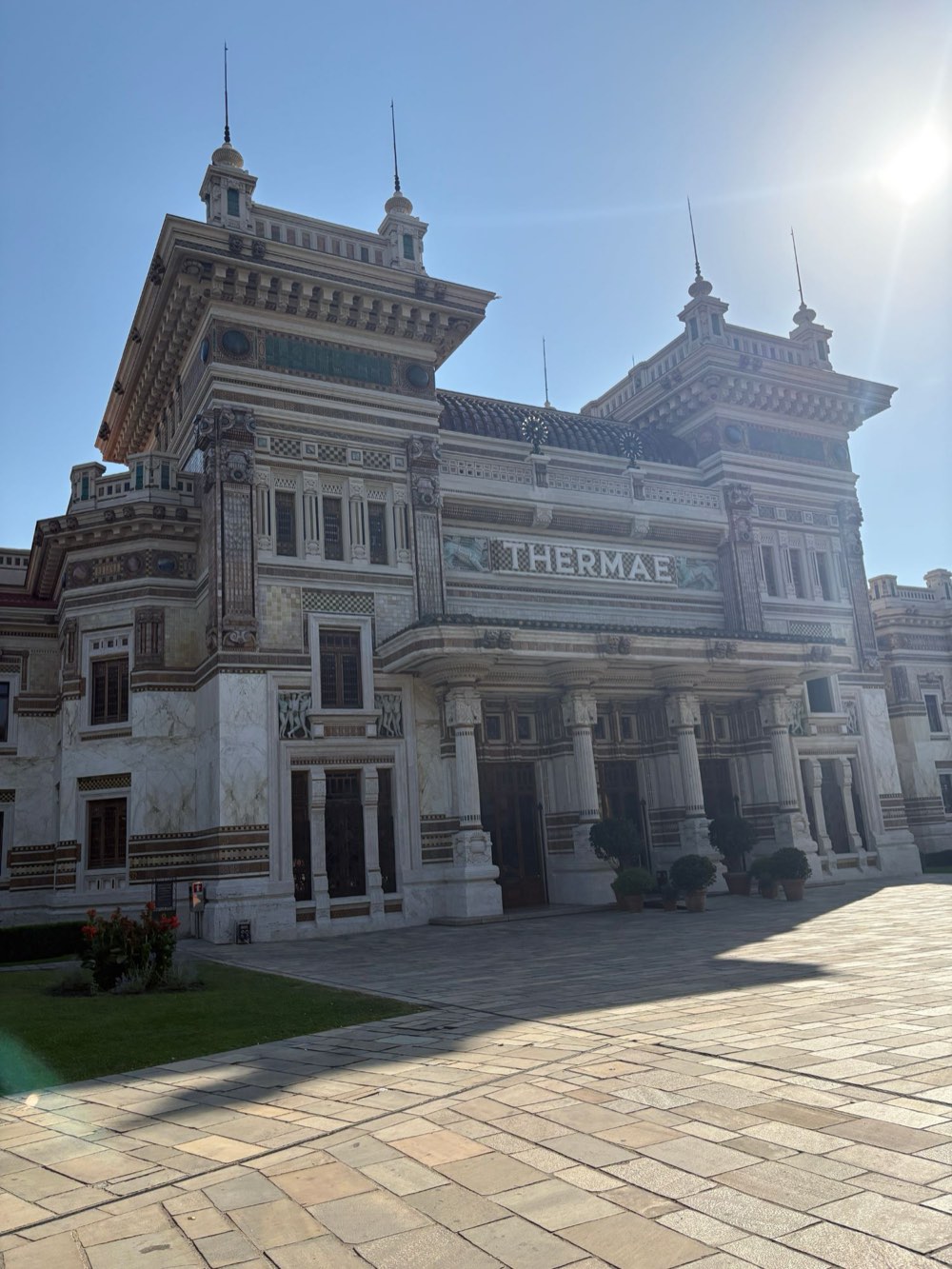
The branch line from Fidenza ends at Salsomaggiore Terme, a town of twenty thousand where the Po plain starts negotiating with the Apennines. In 1911 the Encyclopædia Britannica filed it in four sentences: a village of 1,387 people, six miles from Fidenza, then still called Borgo San Donnino, “by steam tramway”, a popular watering-place whose water “is strongly saline”. Cross the piazza today and the railway stops mattering, because ahead of you stands a palace that has no business in Emilia: columns, spires, odalisques in high relief, two blue lions, and above the portico the word THERMAE spelled in mosaic. Galileo Chini, the Florentine painter who drew the facade, had just spent three years in Bangkok making scenery for the King of Siam. It shows.
The water under the town is the reason any of this exists. Salsomaggiore sits on one of the saltiest springs any European spa has drawn on: cold, dark, pumped from wells 800 to 1,200 metres deep, sixteen degrees Celsius, sixteen degrees on the Baumé scale, roughly 150 grams of salt to the litre, four times the Mediterranean. The name carries the trade: Salsomaggiore, greater salt, against the neighbouring village of Salsominore, lesser salt, and against the salt works whose porticoes housed the first baths. In 1839 a local doctor, Lorenzo Berzieri, put the water’s bromine and iodine on paper; in 1847 the Duchy of Parma licensed a first bathing house; by 1850 a count had fitted twelve bathing cabins under one of the old salt sheds, and the Duchess of Parma, Marie Louise, Napoleon’s second wife, had already made the waters fashionable. The spa traffic did the rest, and the town grew from 1,387 people to twenty thousand on the strength of what comes out of the ground.
The palace in front of you is the third building on the site and the first built as an argument. The company that ran the baths commissioned it in 1912 from the Florentine architects Giulio Bernardini and Ugo Giusti; a 1913 law turned the springs into state property, and the state kept paying. The war stopped the site, Chini redrew the facade when work resumed, and the bill came to 23 million lire, distributed among hundreds of masons and marble workers, the Chini kilns at Borgo San Lorenzo for the ceramics, and the ironworkers who forged the grilles. The old plant next door kept pumping salt water the whole time, so the new palace rose around a live water main. It opened on 27 May 1923, in the presence of the ras of Cremona, Roberto Farinacci, and a train of government ministers, and it was proclaimed the most beautiful baths in the world. For once the proclamation was within reach of the facts.
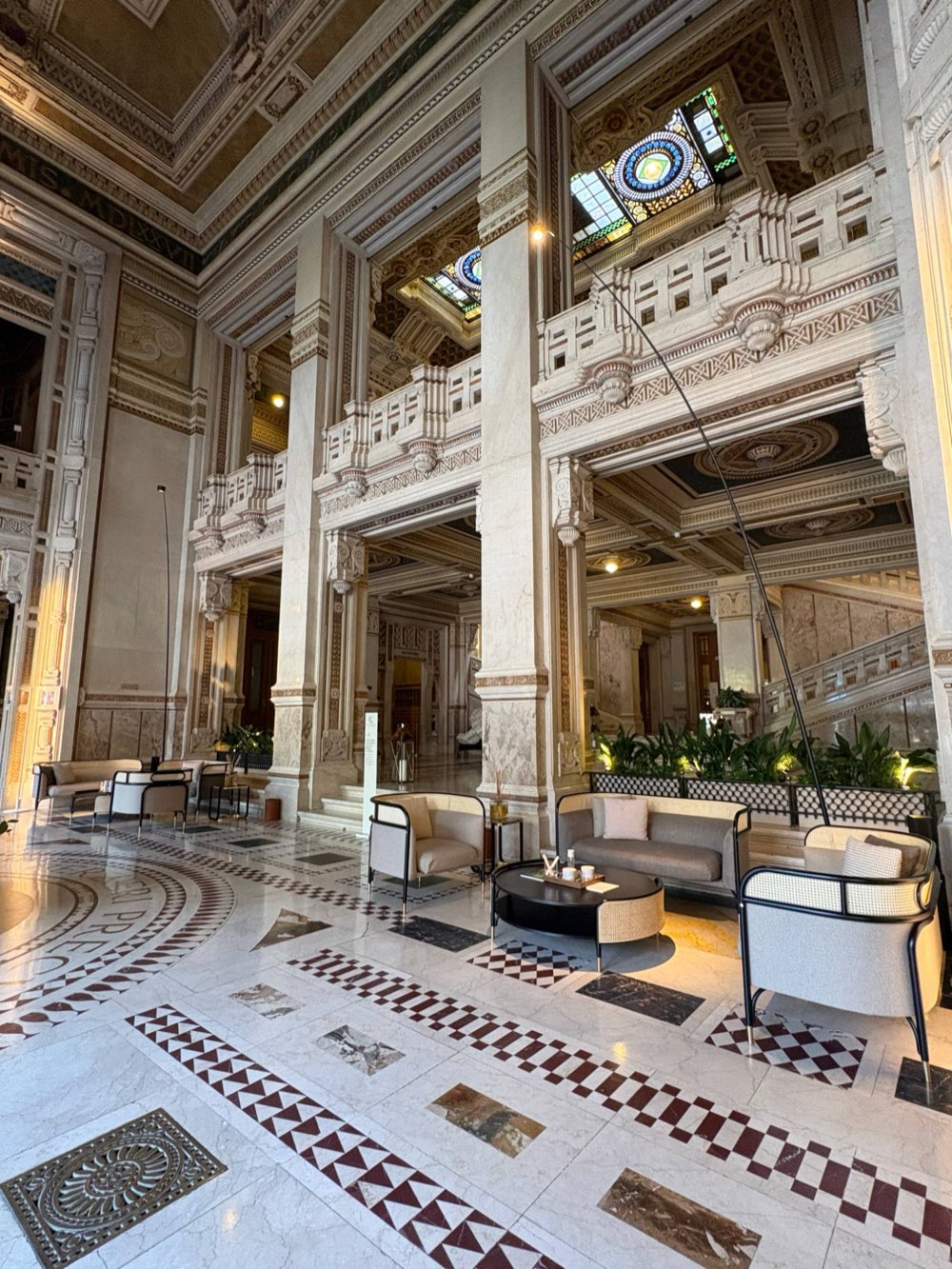
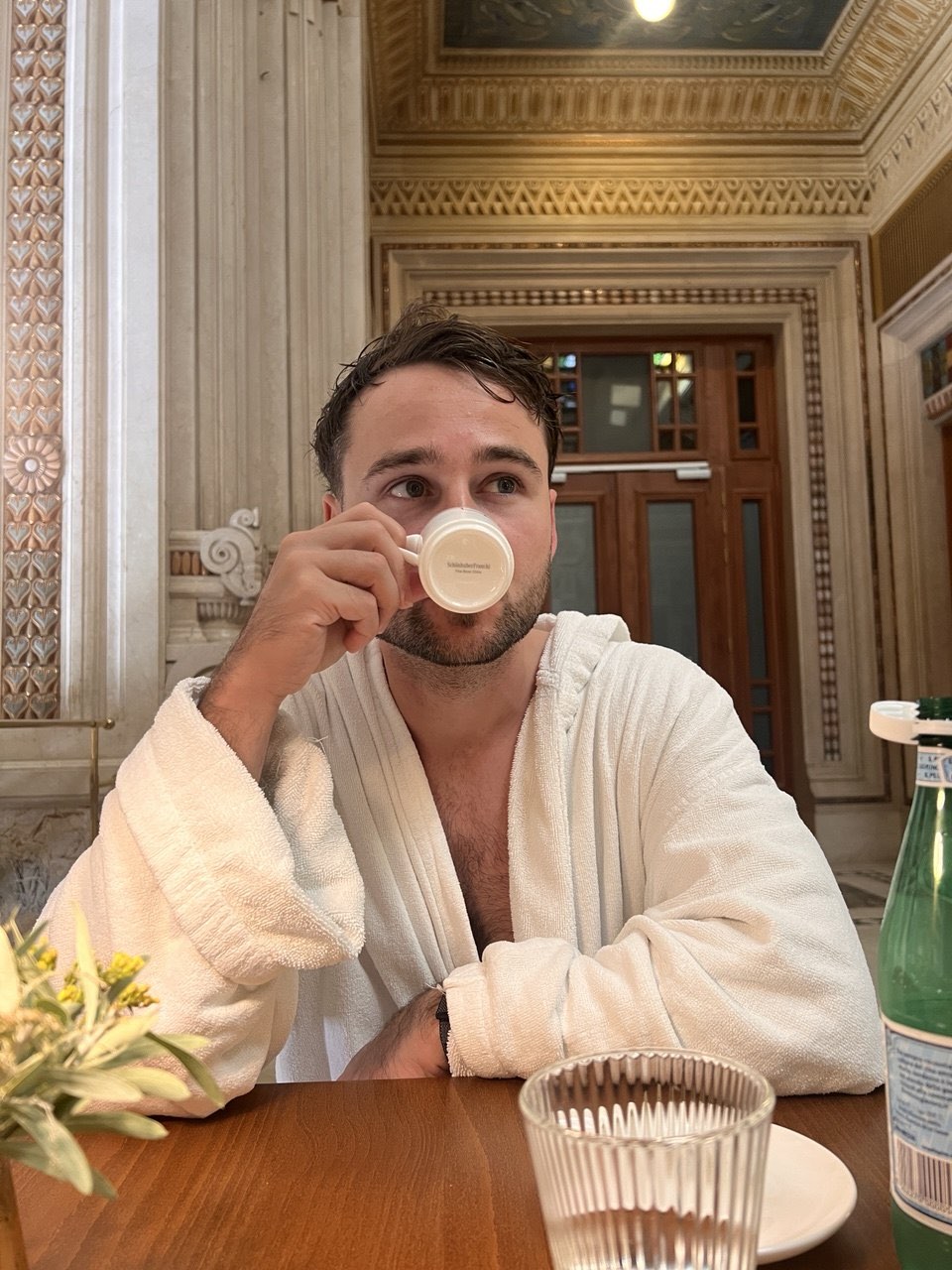
A century later the argument has changed hands. The state lender Cassa Depositi e Prestiti bought the building out of bankruptcy in 2021 and handed it to QC, the spa group whose initials are those of its founding family, Quadrio Curzio. QC reopened it on 19 December 2025 after a restoration of the whole complex, and it now carries the best Italian placing on our list: N° 30 of Saunas & Baths 2026. I bought a day ticket, from €72, with robe, towel, slippers and the evening aperitif included, and walked into the atrium: two storeys of marble, the floor a chessboard underfoot, stained glass in blue and green over the entrance, the goddess Hygeia painted on the far wall, and on the piano nobile Chini’s frescoes of Autumn and Spring, painted in 1922. An espresso arrives at the café table under the stucco.
The visit splits in two. In the palace you keep the robe on: changing rooms with a coded locker, creams and GHD straighteners provided, then saunas and relaxation rooms arranged like chapters. One room hangs with hot-air balloons and rocks you in suspended beds; one puts you on warm waterbeds under slow projections; one is a bookcase shelved upside down; the storm room sends real rain down its glass and answers with thunder. Each corridor has its own scent, printed on the sign at the door. I sat through two full cycles of the storm, and the robes around me were identical, which makes half the afternoon a quiet negotiation over whose is whose.
Then the route pushes you outside, across the courtyard, into the building that once made the whole thing run: the old centrale termica, the machine hall that heated and powered the baths. It is the honest half, exposed concrete and grey steel, with pools stacked on four floors. There is a pool with a glass floor, suspended over the room below. There is a pool that plays music underwater, which sounds like a gimmick and works like a sedative. There are experience showers, a grotto, and then the stairs to the roof, where three open-air pools sit above the tiled roofs of the town with steam going up. At dusk, with the first hills of the Apennines behind, it is the best view any pool in the Po valley has.
Which brings me to the water, and the one fact the mosaics never mention: it is not thermal. The pools of the Thermae Berzieri are filled with treated fresh water, chlorinated enough to smell of the municipal pool by late afternoon. The real water, the 150-gram stuff, still runs, but for the town’s medical terme, which draw it for cures and mud. At QC you bathe in the palace and drink the history; the salt stays outside. I worked it out halfway through the visit, floating in the suspended pool over the entrance hall: the palace is the argument, the water is the pretext. The afternoon crowd is the second test, and both yield to the same answer: the building does its best work in the evening, on the after-19:30 ticket, when the day crowd has gone and the palace returns to something its architects would recognise. The aperitif, taken on the first-floor balcony between the frescoes, is included and generous, and the buffet takes the kitchen of Parma seriously, as it should half an hour from Parma.
Our rank rests on the circuit and above all on the building, and the visit left N° 30 standing. The palace is the pool. The water is municipal.
Practical
QC Spa Salsomaggiore, Piazza Lorenzo Berzieri 1, Salsomaggiore Terme. Entry from €54 for five hours, €72 all day, €44 after 19:30; robe, towel, slippers and the evening aperitif are included. Open 9 to 23, to midnight on Friday and Saturday. No children under 14. Midweek evenings are quiet; Sunday afternoons are not. The pool water is fresh, not thermal; the salso-bromo-iodic cures continue at the town’s medical terme and at Tabiano.
- Gazzetta di Parma: the restoration and reopening of the Berzieri, 20 December 2025.
- Encyclopædia Britannica, 11th ed., 1911: entry “Salsomaggiore”.