Postojna Cave
The largest show cave in Europe has run a railway under its mountain since 1872, lit its halls before Ljubljana had electric light, and hatched its baby dragons on camera in 2016.
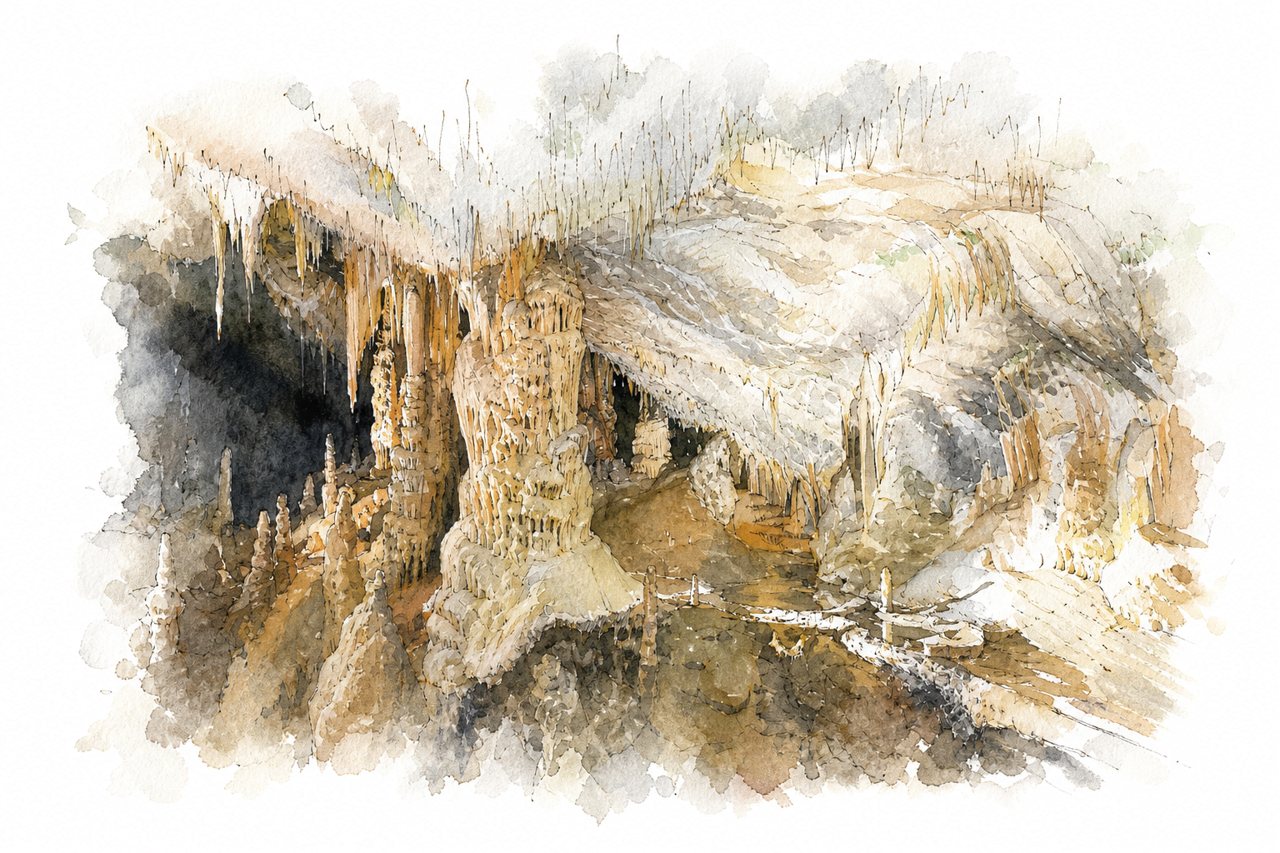
Postojna is a small town on the road between Ljubljana and the Adriatic, and the cave is the reason it looks the way it does: hotels at the gate, a railway station a walk away, souvenir shops selling the same plush dragon in nine sizes. The capital is 46 kilometres off. The entrance itself is a dark opening in the base of a grey hillside, and the queue for it folds along the rock face, where the air from inside meets the summer heat. The cave holds ten degrees all year and breathes it out at the door. I took a morning tour in July, watched the trains disappear into the cliff on a double track, and stepped into a carriage with about as much ceremony as boarding a tram.
The place has been in the tourism business for two hundred years. Valvasor described the cave in the 17th century, and there is graffiti inside from 1213, but the modern cave begins in 1818, when the passages were being cleared for a visit by Francis I, emperor of Austria, and a local man in charge of the lamps, Luka Čeč, walked past where the prepared route ended and found the great halls beyond it. Archduke Ferdinand came in 1819, the cave was declared a tourist destination, Čeč became its first guide, and the guide service has counted itself as working since 1824. Rails went down in 1872, the first railway in any cave in the world, and for the first decades the guides pushed the carriages themselves; a gas locomotive took over around 1900, and an electric one after 1945. Electric light came in 1884, before Ljubljana had it. The First World War brought Russian prisoners, who were put to work building a bridge across an underground chasm. The Second brought the German army, which stored close to a thousand barrels of aircraft fuel in the galleries; Slovene partisans set it alight in April 1944, and the fire burned for seven days, blackening the entrance halls.
The system now measures 24.34 kilometres, mapped by divers as recently as 2015 and 2017, of which about five are open to visitors. The train covers 3.7 of them, an open carriage with a lap bar and a ceiling of rock, squealing through the dark past chambers the lights pick out for a second and drop. It stops at the Big Mountain, and the rest is a kilometre and a half on foot, behind a guide, with an audio commentary in nineteen languages. The route has the same stations it has had for a century: the Great Mountain hall, where the old signatures are preserved on the walls; the Beautiful Caves, the part the Victorians came for; the spaghetti hall; the Dance Hall, hung with Murano glass chandeliers; the Concert Hall, whose acoustics have carried orchestras since before the First World War. The Brilliant, a five-metre stalagmite in bright white flowstone, stands at the turn like a monument on a roundabout, and every camera in the group goes up at once. The whole visit is ninety minutes, at ten degrees, with a jacket.
Then the animals, because the cave is as famous for what lives in it as for what it looks like. The olm, Proteus anguinus, is a blind white amphibian the length of a hand, the largest cave animal in the world and the one locals decided must be a baby dragon: the dragons live in the mountain, the story went, and this is what the young ones look like before they grow up. They can live to a hundred, go without food for up to ten years, and regrow a lost limb. The tour ends at the aquariums, and the olms hang in the water like pale question marks. In January 2016 a female in the show aquarium laid more than fifty eggs, an event almost never seen anywhere, and the cameras the park set up made it a news story worldwide; by July twenty-two had hatched, the first olms known to have been born in front of an audience. The park has spent the decade since turning the hatchlings into celebrities, and the plush dragons at the exit are not a joke so much as a supply chain. There is also, in a side chamber, the world's only underground post office, open since 1899, where you can buy a postcard and post it from under the mountain.
The complaint about Postojna is the one every large show cave in the world gets, and here it is written on the timetable: the tour is a procession. Nearly a million people a year were already coming by the late 1990s, the trains run all day in season, and you walk with your group, stop where the group stops, and keep the pace of a factory floor. The price of the procession is €34.90, plus a booking that in July you want to make in advance, plus boarding fifteen minutes before your slot. What the complaint misses is what the procession buys. The walkways, the lighting, the rails, the two hundred years of guides: none of that runs on a handful of visitors a day, and the alternative, anywhere else, is a lesser cave with the same July crowd squeezed into it without a train. Late afternoon, the last tours thin out, and the Beautiful Caves do what they did to Archduke Ferdinand.
The verdict comes easily. Postojna is N° 1 of Show Caves 2026, the only cave in the top ten you ride into, and the visit left the rank standing. The railway is not a gimmick, it is the oldest exhibit, and the cave under it is one of the few places where the tour, the animal and the building are all the same age. The dragons help.
Practical
Postojna Cave, Jamska cesta 30, 6230 Postojna, Slovenia; 46 km from Ljubljana, about an hour by train or car. Open daily, all year, in all weather. Tour 90 minutes, from €34.90, by timed entry; book online in season and board 15 minutes before the slot. The Two Adventures package with Predjama Castle is €49.90, the 100% Cave Experience with the Vivarium and EXPO is €44.40. Ten degrees inside; jacket and closed shoes. Audio guides in 19 languages; the underground post office sells postcards; the plush olms are hard to resist and impossible to justify.
- Postojna Cave Park, official site, 2026: ticket prices and packages, the 39-million visitor count, the guiding service since 1824, the 2016 olm hatching.
- Delo, 30 June 2015, and Dnevnik, 18 May 2017: the cave dives that mapped the system to 24,340 metres.
- Šerko and Mishler, The Postojna Grottoes and the Other Marvels of the Karst, 1967: the 1944 fuel fire.