Petra
A city that lived by selling water in a desert, died by an earthquake and the sea routes, and was lost to the West for a thousand years. The ticket now costs fifty dinars and the water comes in bottles.
Wadi Musa is a town strung along a ridge above the valley that gives it a name, three hours from Amman down the Desert Highway, and it exists to sell one thing over and over: the gate at the bottom of its hill. At the visitor centre a ticket costs 50 dinars if you are staying the night in Jordan, which is the entire cost of a decent hotel anywhere else in the country, and your passport is checked at the desk, and again later, because the ticket is checked like a border. Then the road drops, past the Djinn blocks and the Obelisk Tomb, and a man with a horse offers you the ride that is included in the ticket. The ride is included. What happens at the end of it, between you and him, is a separate negotiation, and this is the first lesson of Petra: everything the Nabataeans once charged for, someone here still charges for.
The city they built was a service station for the incense road, and what they were really selling was water. The Nabataeans were Arab traders who settled in these cliffs by the second century BC and grew rich taking a cut of everything that moved between Arabia and the Mediterranean, up to 20,000 people at the peak. In a desert basin where the rain arrives as floods, they built dams, cisterns, channels and ceramic pipelines, diverted the flash floods through a tunnel at the entrance of the gorge, and made a place where camels could drink and merchants could pay for the privilege. The carvings everyone comes for are the fortune the water made. Rome annexed the kingdom in 106 AD and Trajan ran his new road through it; an earthquake in 363 broke the water system; the sea routes and Palmyra took the trade, and the city emptied out, held a Crusader castle for a while, and vanished from Western knowledge. In 1812 a Swiss traveller, Johann Ludwig Burckhardt, heard of a dead city near the tomb of the prophet Aaron, dressed as a Bedouin under the name Sheikh Ibrahim, walked in with a goat he said he meant to sacrifice at the tomb, and became the first European in a thousand years to see the Treasury.
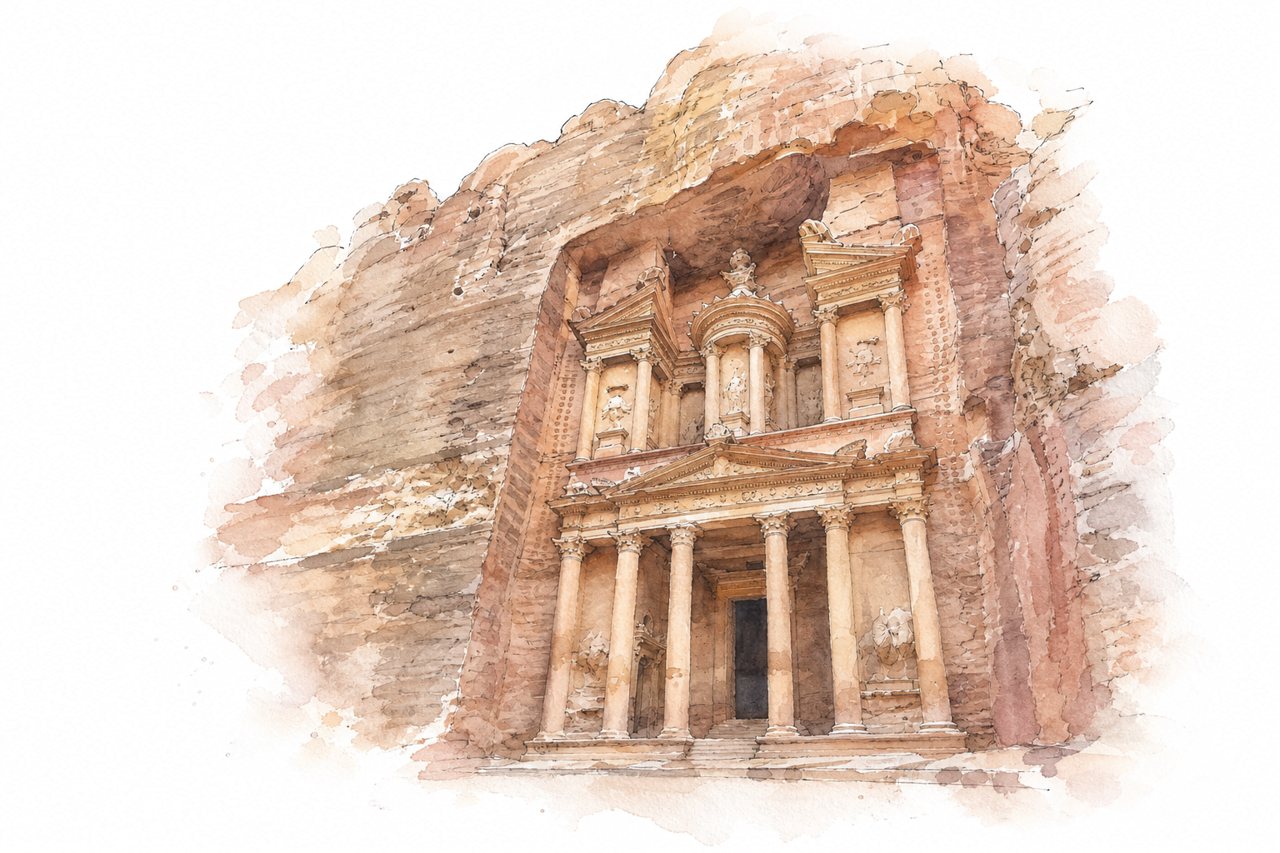
What he saw, and what everyone still sees first, is the reveal, and no photograph has ever settled it. The Siq is a gorge a little over a kilometre long, in places three or four metres wide, and the walk through it is the best approach in the category: water channels cut at waist height in the walls, votive niches, the squeeze where the sky is a ribbon, and then the wall opens on the left and there it stands in a pocket of light: the Khazneh, the Treasury, probably the tomb of the king Aretas IV, its urn pocked with rifle shots from men who believed the gold was inside. A queue of camels waits in front of it for the photographers. Beyond, the valley widens into a city: the Street of Facades, the theatre cut for an audience of eight and a half thousand with the tombs it ate still visible in the rows, the Royal Tombs, the Urn Tomb that became a church in 446, the Roman colonnaded street and the one temple that was never carved into anything, Qasr al-Bint. Then the mountain trails: the Monastery up some eight hundred rock-cut steps, its facade as wide again as the Treasury's and one of the largest monuments in the city; the High Place of Sacrifice up about the same again; and the viewpoints across from the Treasury, reached on a trail that costs 15 dinars, where the facade is seen whole from above and the crowd below reduced to scale. Most visitors walk eight kilometres and see one facade. The city deserves two days.
The catches are honest ones and worth stating plainly. The heat in summer is mid-thirties and the second litre of water is not optional. The distances are real; the club car from the visitor centre to the Treasury is 15 dinars each way, the donkey handlers are persistent, and in December 2022 the valley flooded and the site was cleared of visitors in an afternoon, a thing the Nabataeans had engineered against two thousand years earlier. The ticket that covers one day costs 50 dinars, two days 55, three 60, and a same-day visit without an overnight stay in Jordan costs 90; children under 12 walk in free; and the Jordan Pass, bought before arrival, settles the visa and the entry together. The Treasury at ten in the morning is a market square. At four in the afternoon, when the day-trippers have gone, it is possible to stand in the Siq and hear nothing but the water channels, which no longer carry water, still humming with the idea of it.
Petra is N° 2 of Archaeological Sites & Ruins 2026. The list puts one site above it, Calakmul, a Maya capital at the end of a hundred kilometres of forest road where the visitors per day can be counted in the tens; Petra takes more than a million a year and asks you to share. The rank stands, because what is being ranked is the site, not the solitude, and the site is the most complete city the ancient world left in rock. The water engineers get the last word: they built the reveal, and the queues now stand where the caravans used to.
Practical
Petra Visitor Centre, Wadi Musa, Jordan; three hours from Amman by road. Open 6 to 18 in summer, 6.30 to 17 in winter. Entry 50 JD one day, 55 JD two consecutive days, 60 JD three; 90 JD for a same-day visit without an overnight stay in Jordan; children under 12 free; passport required at the ticket office; the Jordan Pass waives the visa and the entry fee. The Treasury viewpoint trail is 15 JD, the club car from the visitor centre 15 JD one way, the 4x4 shuttle to the Monastery trail 5 JD. Petra by Night is ticketed separately and needs a daytime ticket too. Closed shoes, two litres of water, and two days if you can spare them.
- PDTRA, visitpetra.jo, 2026: ticket prices, opening hours, the Siq's length, the trails and shuttle prices.
- UNESCO World Heritage List, entry 326, inscribed 1985: the Nabataean water system and the site's extent.
- Encyclopædia Britannica, 11th ed., 1911: the Siq, the theatre, the tomb facades and Burckhardt's rediscovery.