Kirstenbosch
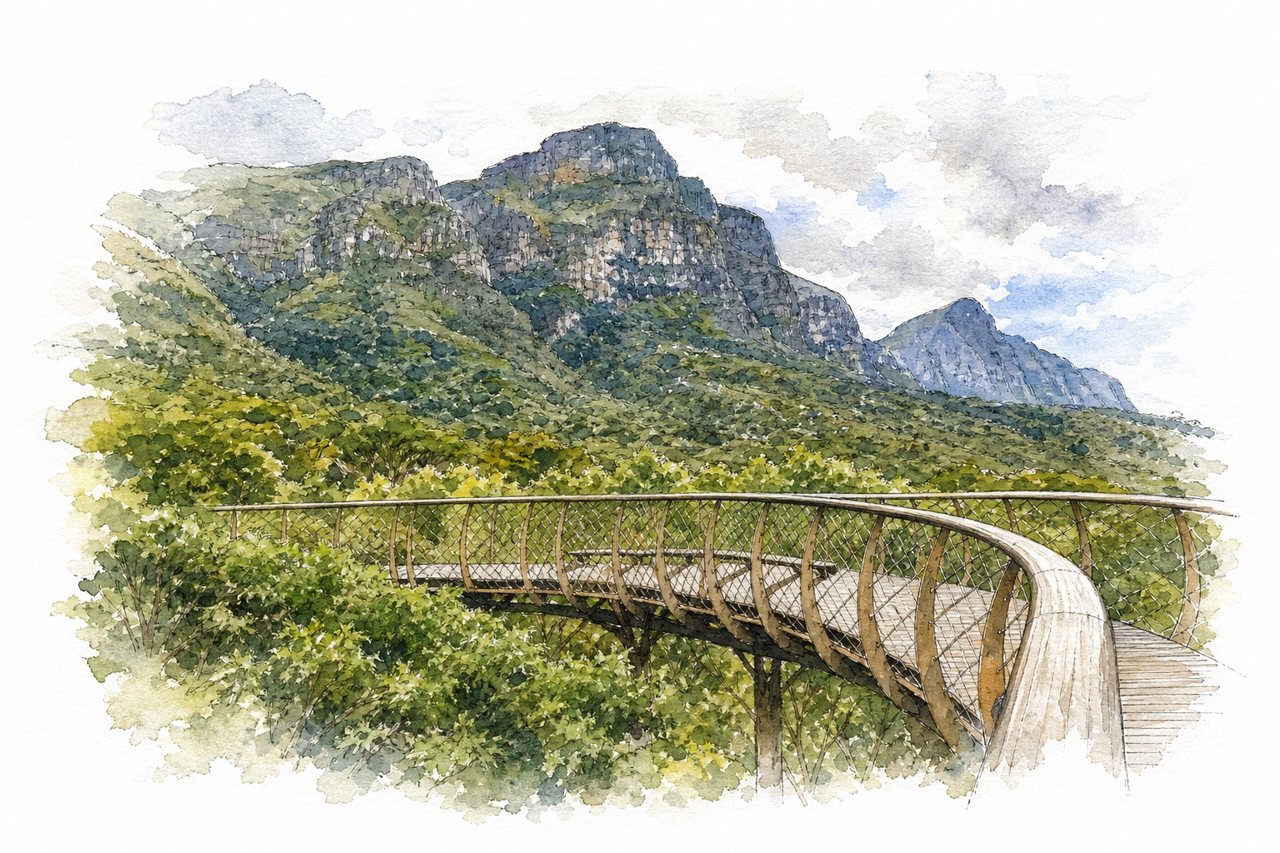
Rhodes left the nation a farm under Table Mountain, and in 1913 a Cambridge botanist planted it with South African flowers only, the first garden in the world on that principle. The walkway over the trees is shaped like a snake skeleton.
The garden sits 13 kilometres from the centre of Cape Town, on the eastern slope of Table Mountain, and the drive out ends at a stone gate with a queue of cars that locals know how to work through. Inside, the first thing the place does is stop pretending the mountain is scenery. The lawns run up to the rock, the rock takes over, and the whole back wall of the garden is cliff. On the lawn itself, before any planting has registered, there are dassies: rock hyraxes, the size of a loaf and the confidence of something that knows it is protected, sitting in family groups on the warm stones, waiting for the picnics to start.
The land was being used hard before it was a garden. Jan van Riebeeck ordered a hedge of wild almond and brambles planted around the Dutch Cape Colony in 1660, and stretches of that hedge still stand at the top of the garden, a provincial heritage site you can walk to; the farm took its name from a manager called Kirsten; a Colonel Bird built a house and a spring-fed bath in 1811, and the bath is still there. Cecil Rhodes bought the estate in 1895, planted the camphor avenue in 1898, and left it to the nation when he died in 1902. What the nation did with it is the reason this garden is on the list: in 1913 it set the ground aside as a botanical garden that would grow South African plants only, the first garden in the world founded on that rule, at a time when every other great garden was still collecting the planet. The first director, Harold Pearson, a Cambridge botanist who had come out to a chair in Cape Town, took the job without pay, lived in the garden in what the record calls reduced circumstances, budgeted the government's £1,000 a year against weeds, pigs and orchards, planted the cycads in the Dell that stand there now, and died of pneumonia in 1916. He is buried in his garden. The epitaph reads: if ye seek his monument, look around.
The walk works outward and upward from the lawns. The beds are planted by the vegetation they show rather than by gardening fashion: protea beds where the sunbirds work the flower heads all morning; the erica slopes; the fynbos sections, the Cape's own heath, which flowers in a rolling year of pinks and whites; a fragrance garden, a useful-plants garden, a mathews rockery built into the hillside; the cycad amphitheatre around Pearson's Dell; a conservatory with the baobabs and quiver trees of the dry country, open nine to five. Then the Boomslang. The Centenary Tree Canopy Walkway was built in 2013 and 2014 out of steel and slatted pine, paid for by bequests, and named for the tree snake it resembles: a ribcage of a bridge, 130 metres long, that leaves the forest floor, rises through the arboretum canopy and lifts you twelve metres above the ground at its hump, with the garden falling away below and the Cape Flats laid out to the east. There is no extra charge for it, and there is no rail on the view. It carries the smell of the trees along with it, which the stone parts of the garden do not.
Above the walkway the garden stops administrating and becomes a trailhead. Paths run up the ravines to the summit of the mountain; Skeleton Gorge, also called Smuts' Track after the prime minister who walked it regularly, is the standard route up, and the contour path runs off through the forest towards Constantia Nek. On a summer Sunday the concert lawn fills for the sunset concerts, thousands of people with picnic baskets and blankets from late afternoon, and the garden is as much an amphitheatre as a collection that evening. What catches visitors instead is smaller: the price ladder, which is R270 for adults from outside Africa and R110 for locals with proof of residence, and card only, no cash; the weather, because the mountain makes its own and the tablecloth can drop the temperature ten degrees in the time a picnic takes; and the gradients, which are serious enough that the walkway's own access notes ask for wheelchair assistance on the slopes. The dassies bite when fed, which does not stop anyone from feeding them.
Kirstenbosch is N° 3 of Botanical Gardens 2026, below a colonial test garden on the Bay of Algiers and a quarry turned garden on Vancouver Island, and the visit left the rank exactly where it was. The place has spent a century proving a principle, all-South-African planting, and it has the setting to make the principle look inevitable. Its exhibit at Chelsea has taken 29 gold medals in 33 appearances, which is a nice detail but not the argument; the argument is the mountain, the boomslang, and a founder buried under his own cycads.
Practical
Kirstenbosch National Botanical Garden, Rhodes Drive, Newlands, Cape Town; 13 km from the centre, free parking at Gates 1, 2 and 3, hop-on bus from the city daily. Open every day, 8 to 19 September to March, 8 to 18 April to August; conservatory 9 to 17. Adults from outside Africa and SADC R270, African nationals R150, South African and SADC residents R110 with ID, children 6 to 17 R40, over-60s free on Tuesdays; card payments only. The Tree Canopy Walkway is included. Picnics allowed; dogs are not. Sunday sunset concerts in summer, ticketed separately. Guided tours daily at 10, 11 and 14. Do not feed the dassies.
- SANBI, official site, 2026: admission fees and opening times, the Boomslang's length, height, cost and opening on 17 May 2014.
- Huntley, Brian J., Kirstenbosch: The Most Beautiful Garden in Africa, 2012: the 1913 founding, Pearson's unpaid years, the burial and epitaph.
- Green, Lawrence, In the Land of Afternoon, 1949: Van Riebeeck's 1660 hedge and the early farm.