Changi
The most-awarded venue on our lists is an airport. Singapore spent 1.7 billion dollars on a mall wrapped around a forty-metre waterfall, and locals visit it on Saturdays like a park.
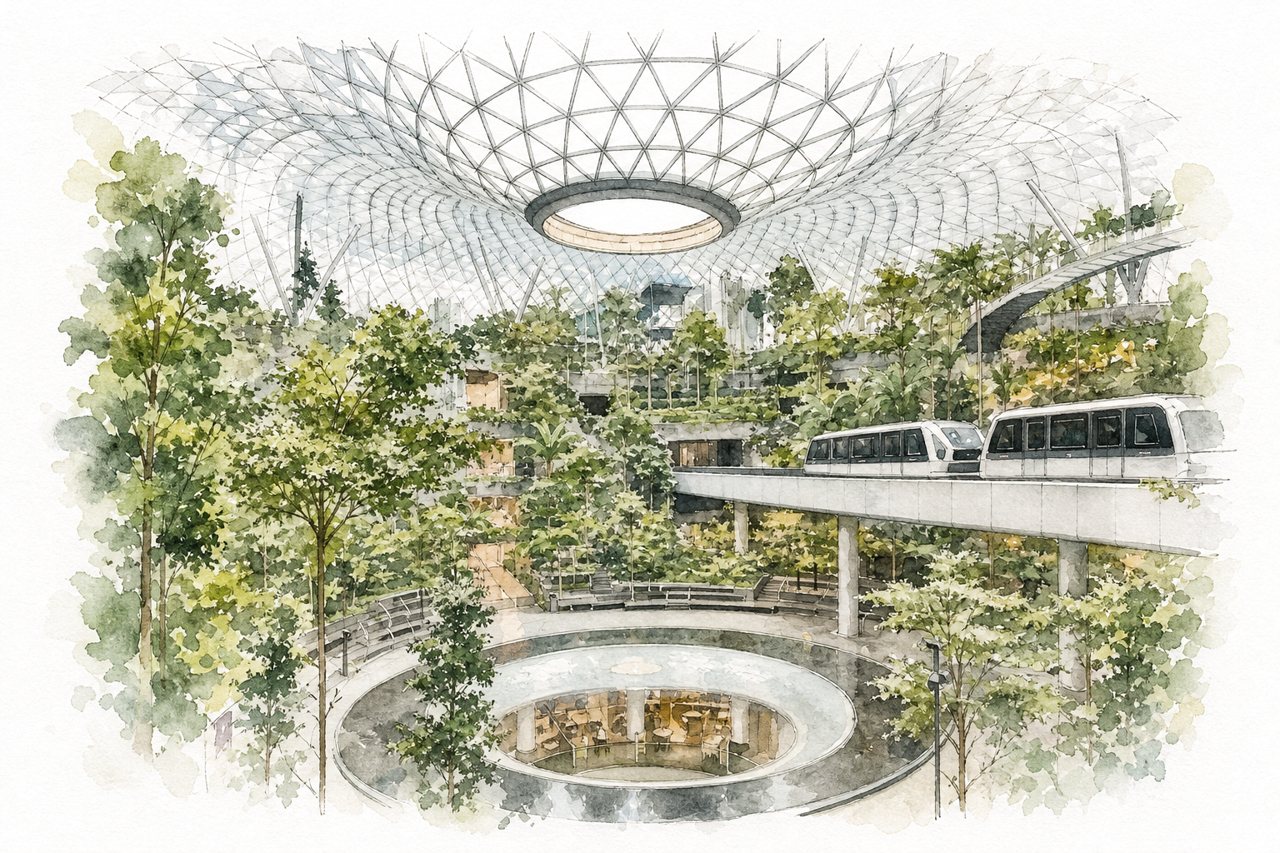
The MRT train to Changi Airport is a city line that happens to end at the world’s highest-ranked airport, and the walk from the platform to Jewel, the glass doughnut between the terminals, is through the kind of mall corridor Singapore does on autopilot. Then the corridor ends and the building does the thing it was built to do: a hole in the roof, a waterfall falling forty metres through the middle of a forest, and every person in the building photographing it from the rail on every level. Nobody checks a boarding pass. Changi is the only airport on earth where arriving with nothing to fly on and nowhere to be is a normal way to spend a Saturday, and on weekends the locals outnumber the passengers the way a park outnumbers its staff.
The airport was a decision taken in 1975, when the old field at Paya Lebar was hemmed in by the city it had grown next to, and the government moved civil aviation to the eastern tip of the island so the planes would take off and land over the sea instead of over flats. The first flight arrived on 1 July 1981 at ten past seven in the morning: SQ101, 140 passengers from Kuala Lumpur, and the airport ended its first year with 12.1 million of them. Terminal 2 came in 1990, Terminal 3 in 2008, Terminal 4 in 2017. In 2025 the count reached 69.98 million passengers, the busiest year in its history, about one movement every eighty seconds around the clock. The awards have become a rounding error: more than 700 since opening, 28 of them titled Best Airport in 2025 alone. And in the middle of it, on the site of the old Terminal 1 car park, the state's developer and its mall company spent S$1.7 billion of their own money on Jewel, designed by Moshe Safdie with the local firm RSP, and opened it in 2019. Fifty million people came through in the first six months. In 2024 the footfall was 80 million, which is more than the number of passengers the airport next to it carried. The mall outdrew the airport.
What the non-flying visitor gets, floor by floor: the Shiseido Forest Valley, five storeys of indoor hillside planted with about 3,000 trees and 60,000 shrubs of 120 species, with walking trails that wind up through it; the Rain Vortex itself, rainwater pumped to the oculus and dropped at up to 37,850 litres a minute, which by night becomes the screen for a light show; and at the top, the Canopy Park, a garden with a mirror maze, a hedge maze, discovery slides, a suspension bridge 23 metres above the floor with a glass panel to stand on, and two nets, one for bouncing 250 metres across the sky and one for walking. The attractions are priced one by one; the valley, the vortex and the air conditioning are free. The food courts do the local dishes at prices that shame the city centre. The Skytrain to the terminals slides past the waterfall in plain view. It is, in the honest phrasing of its own architect, a marketplace combined with a park, and it works better than the sentence suggests.
Here is the catch, and it is the one the list has to face. Almost everything Changi is famous for is behind the gate. The butterfly garden, the sunflower garden, the free cinema, the pool: all airside, reachable only with a boarding pass and a security queue. The free city tour for transit passengers, two hours of Singapore between connections, is not for visitors. The non-flying day at Changi is a day at Jewel, which is to say a very good mall with the world's best waterfall in it, plus the walkways to three terminals of further malls. Locals treat it exactly as such; the crowds on a Sunday are families, courting couples and a lot of Pokemon Centre traffic, and the queue for the car park is the least charming thing in Singapore. The airport has also grown so good at being a destination that its destination-ness is expanding to match: Terminal 5 broke ground in May 2025 and will open in the mid-2030s with room for 50 million more passengers, on reclaimed land, with its own shopping. The waterfall will no longer be the biggest thing at Changi. It will be the oldest trick.
The rank is N° 1 of Airports 2026, and the visit left it standing, for a strange reason worth stating. Changi wins because it treats the airport as a piece of the city rather than a queue for leaving it, and no other airport on the list has tried. The competitors are excellent at baggage; Changi is excellent at a Saturday. Take the train out, watch the vortex for an hour, eat a laksa, and go home without once looking at a departure board. That is the verdict, in practice.
Practical
Jewel Changi Airport, 78 Airport Boulevard, linked to Terminals 1, 2 and 3; MRT to Changi Airport station, about 30 minutes from the centre. Jewel is public and free to enter; the Rain Vortex runs all day, with the light show after dark. Canopy Park attractions are ticketed separately; buy ahead on weekends. The butterfly garden, sunflower garden, pool and free city tour are all airside, for departing and transit passengers only. Early check-in at Jewel lets you drop bags hours before the flight. Allow half a day; take the train, not a car.
- Changi Airport Group, 2025 year in review: 69.98 million passengers, one movement every 80 seconds, more than 700 awards.
- The Straits Times, 28 January 2025: Jewel's record 80 million visitors in 2024; 18 October 2019: 50 million in the first six months.
- National Library Board, Infopedia: the 1975 move from Paya Lebar and the first flight on 1 July 1981.